DreamStation BiPAP AVAPS Noninvasive ventilator

Not for sale in the United States

Find similar products

DreamStation BiPAP AVAPS provide appropriate therapeutic support to meet the changing needs of patients over time.¹ The device's algorithms simultaneously and dynamically treat COPD (Chronic Obstructive Pulmonary Diseases) patients with OSA (Obstructive Sleep Apnea) overlap.¹⁻³

Features
Automated Airway Management

Automated Airway Management

DreamStation can automatically and dynamically manage a patient’s upper airway in any ventilation mode. It continuously monitors and reacts to changes in the upper airway at the lowest possible pressure each night. Automated Airway Management's goal is to providing the lowest bi-level pressures to treat the patient's ventilation needs.

Automated Airway Management

Automated Airway Management
DreamStation can automatically and dynamically manage a patient’s upper airway in any ventilation mode. It continuously monitors and reacts to changes in the upper airway at the lowest possible pressure each night. Automated Airway Management's goal is to providing the lowest bi-level pressures to treat the patient's ventilation needs.

Automated Airway Management

DreamStation can automatically and dynamically manage a patient’s upper airway in any ventilation mode. It continuously monitors and reacts to changes in the upper airway at the lowest possible pressure each night. Automated Airway Management's goal is to providing the lowest bi-level pressures to treat the patient's ventilation needs.
Click here for more information
Automated Airway Management

Automated Airway Management

DreamStation can automatically and dynamically manage a patient’s upper airway in any ventilation mode. It continuously monitors and reacts to changes in the upper airway at the lowest possible pressure each night. Automated Airway Management's goal is to providing the lowest bi-level pressures to treat the patient's ventilation needs.
Adapts to changes with AVAPS

Adapts to changes with AVAPS

With Average Volume Assured Pressure Support (AVAPS) DreamStation BiPAP AVAPS delivers customized patient care by automatically adapting to disease progressions and changing patient needs. It helps to maintain optimal patient comfort and supporting patient care and ventilation efficacy while simplifying the titration process.

Adapts to changes with AVAPS

Adapts to changes with AVAPS
With Average Volume Assured Pressure Support (AVAPS) DreamStation BiPAP AVAPS delivers customized patient care by automatically adapting to disease progressions and changing patient needs. It helps to maintain optimal patient comfort and supporting patient care and ventilation efficacy while simplifying the titration process.

Adapts to changes with AVAPS

With Average Volume Assured Pressure Support (AVAPS) DreamStation BiPAP AVAPS delivers customized patient care by automatically adapting to disease progressions and changing patient needs. It helps to maintain optimal patient comfort and supporting patient care and ventilation efficacy while simplifying the titration process.
Click here for more information
Adapts to changes with AVAPS

Adapts to changes with AVAPS

With Average Volume Assured Pressure Support (AVAPS) DreamStation BiPAP AVAPS delivers customized patient care by automatically adapting to disease progressions and changing patient needs. It helps to maintain optimal patient comfort and supporting patient care and ventilation efficacy while simplifying the titration process.
Digital Auto-Trak
Digital Auto-Trak

Digital Auto-Trak

Digital Auto-Trak is an automated breath triggering, cycling and leak compensation algorithm that adjusts ventilation to the patient’s natural breathing patterns. Digital Auto-Trak adapts breath triggering and cycling as the patients disease progresses and helps to eliminate the need for manual adjustments.

Digital Auto-Trak

Digital Auto-Trak
Digital Auto-Trak is an automated breath triggering, cycling and leak compensation algorithm that adjusts ventilation to the patient’s natural breathing patterns. Digital Auto-Trak adapts breath triggering and cycling as the patients disease progresses and helps to eliminate the need for manual adjustments.

Digital Auto-Trak

Digital Auto-Trak is an automated breath triggering, cycling and leak compensation algorithm that adjusts ventilation to the patient’s natural breathing patterns. Digital Auto-Trak adapts breath triggering and cycling as the patients disease progresses and helps to eliminate the need for manual adjustments.
Click here for more information
Digital Auto-Trak
Digital Auto-Trak

Digital Auto-Trak

Digital Auto-Trak is an automated breath triggering, cycling and leak compensation algorithm that adjusts ventilation to the patient’s natural breathing patterns. Digital Auto-Trak adapts breath triggering and cycling as the patients disease progresses and helps to eliminate the need for manual adjustments.
Clinically proven solutions

Clinically proven solutions

Independently verified outcomes highlight the reduction or normalization of PtcCO2.¹,² The addition of the AVAPS ventilation feature to BPV-S/T (Bi-level Pressure Ventilation with Spontaneous/Time Mode) provides beneficial physiological improvements, resulting in a more efficient decrease of PtcCO2 compared to BPV-S/T therapy alone.¹,²

Clinically proven solutions

Clinically proven solutions
Independently verified outcomes highlight the reduction or normalization of PtcCO2.¹,² The addition of the AVAPS ventilation feature to BPV-S/T (Bi-level Pressure Ventilation with Spontaneous/Time Mode) provides beneficial physiological improvements, resulting in a more efficient decrease of PtcCO2 compared to BPV-S/T therapy alone.¹,²

Clinically proven solutions

Independently verified outcomes highlight the reduction or normalization of PtcCO2.¹,² The addition of the AVAPS ventilation feature to BPV-S/T (Bi-level Pressure Ventilation with Spontaneous/Time Mode) provides beneficial physiological improvements, resulting in a more efficient decrease of PtcCO2 compared to BPV-S/T therapy alone.¹,²
Click here for more information
Clinically proven solutions

Clinically proven solutions

Independently verified outcomes highlight the reduction or normalization of PtcCO2.¹,² The addition of the AVAPS ventilation feature to BPV-S/T (Bi-level Pressure Ventilation with Spontaneous/Time Mode) provides beneficial physiological improvements, resulting in a more efficient decrease of PtcCO2 compared to BPV-S/T therapy alone.¹,²
Noninvasive auto-titrating ventilation

Noninvasive auto-titrating ventilation

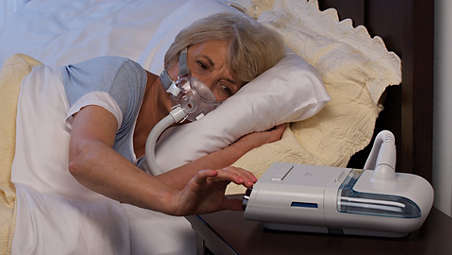
AVAPS-AE* is designed to address common ventilation concerns such as gas exchange, airway patency, and asynchrony.¹ In a pre and post interventional trial, AVAPS-AE* provided adequate control of nocturnal hypoventilation and upper airways obstruction as well as enhancing sleep efficiency and NIV adherence.²

Noninvasive auto-titrating ventilation

Noninvasive auto-titrating ventilation
AVAPS-AE* is designed to address common ventilation concerns such as gas exchange, airway patency, and asynchrony.¹ In a pre and post interventional trial, AVAPS-AE* provided adequate control of nocturnal hypoventilation and upper airways obstruction as well as enhancing sleep efficiency and NIV adherence.²

Noninvasive auto-titrating ventilation

AVAPS-AE* is designed to address common ventilation concerns such as gas exchange, airway patency, and asynchrony.¹ In a pre and post interventional trial, AVAPS-AE* provided adequate control of nocturnal hypoventilation and upper airways obstruction as well as enhancing sleep efficiency and NIV adherence.²
Click here for more information
Noninvasive auto-titrating ventilation

Noninvasive auto-titrating ventilation

AVAPS-AE* is designed to address common ventilation concerns such as gas exchange, airway patency, and asynchrony.¹ In a pre and post interventional trial, AVAPS-AE* provided adequate control of nocturnal hypoventilation and upper airways obstruction as well as enhancing sleep efficiency and NIV adherence.²
Patient driven design

Patient driven design

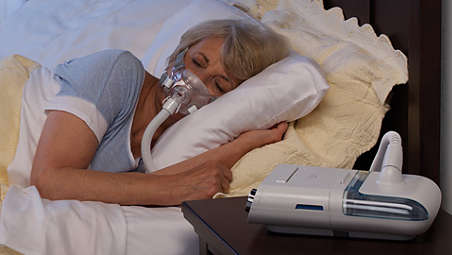
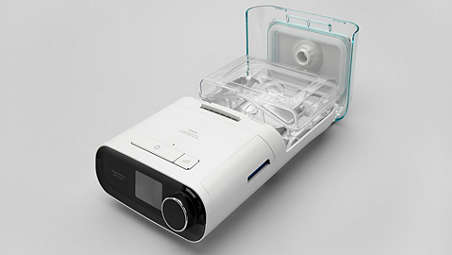
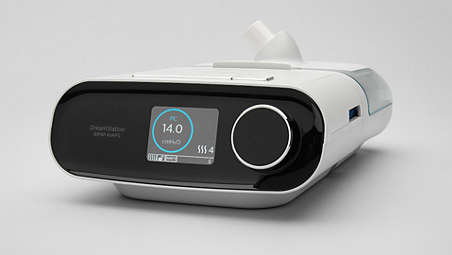
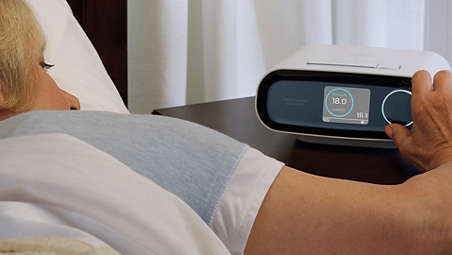
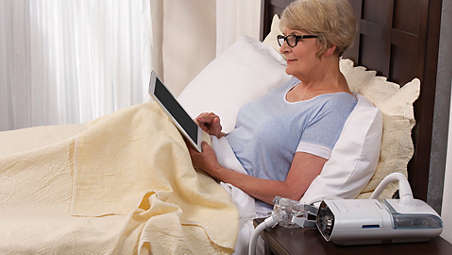
DreamStation’s sleek, stylish, low-profile design offers the important features patients told us they wanted in a therapy device. It’s small and light, making it easy to sit on a nightstand. It features easy-to-navigate menus, a front-facing display that can be operated while lying down or sitting up in bed, as well as an easy-to-clean, one-piece humidifier water chamber.

Patient driven design

Patient driven design
DreamStation’s sleek, stylish, low-profile design offers the important features patients told us they wanted in a therapy device. It’s small and light, making it easy to sit on a nightstand. It features easy-to-navigate menus, a front-facing display that can be operated while lying down or sitting up in bed, as well as an easy-to-clean, one-piece humidifier water chamber.

Patient driven design

DreamStation’s sleek, stylish, low-profile design offers the important features patients told us they wanted in a therapy device. It’s small and light, making it easy to sit on a nightstand. It features easy-to-navigate menus, a front-facing display that can be operated while lying down or sitting up in bed, as well as an easy-to-clean, one-piece humidifier water chamber.
Click here for more information
Patient driven design

Patient driven design

DreamStation’s sleek, stylish, low-profile design offers the important features patients told us they wanted in a therapy device. It’s small and light, making it easy to sit on a nightstand. It features easy-to-navigate menus, a front-facing display that can be operated while lying down or sitting up in bed, as well as an easy-to-clean, one-piece humidifier water chamber.
Remote patient monitoring

Remote patient monitoring

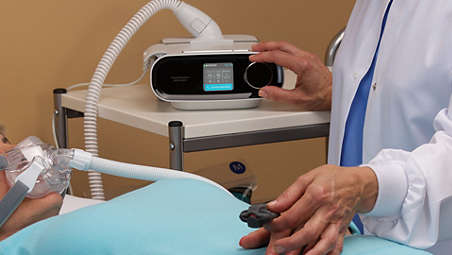
Connected to Care Orchestrator**: DreamStation provides remote connectivity, therapy data transmission and prescription changes to help improve patient care and compliance. The DreamMapper patient application provides daily feedback and helps patients take an active role in their therapy management.

Remote patient monitoring

Remote patient monitoring
Connected to Care Orchestrator**: DreamStation provides remote connectivity, therapy data transmission and prescription changes to help improve patient care and compliance. The DreamMapper patient application provides daily feedback and helps patients take an active role in their therapy management.

Remote patient monitoring

Connected to Care Orchestrator**: DreamStation provides remote connectivity, therapy data transmission and prescription changes to help improve patient care and compliance. The DreamMapper patient application provides daily feedback and helps patients take an active role in their therapy management.
Click here for more information
Remote patient monitoring

Remote patient monitoring

Connected to Care Orchestrator**: DreamStation provides remote connectivity, therapy data transmission and prescription changes to help improve patient care and compliance. The DreamMapper patient application provides daily feedback and helps patients take an active role in their therapy management.
  • Automated Airway Management
  • Adapts to changes with AVAPS
  • Digital Auto-Trak
  • Clinically proven solutions
See all features
Automated Airway Management

Automated Airway Management

DreamStation can automatically and dynamically manage a patient’s upper airway in any ventilation mode. It continuously monitors and reacts to changes in the upper airway at the lowest possible pressure each night. Automated Airway Management's goal is to providing the lowest bi-level pressures to treat the patient's ventilation needs.

Automated Airway Management

Automated Airway Management
DreamStation can automatically and dynamically manage a patient’s upper airway in any ventilation mode. It continuously monitors and reacts to changes in the upper airway at the lowest possible pressure each night. Automated Airway Management's goal is to providing the lowest bi-level pressures to treat the patient's ventilation needs.

Automated Airway Management

DreamStation can automatically and dynamically manage a patient’s upper airway in any ventilation mode. It continuously monitors and reacts to changes in the upper airway at the lowest possible pressure each night. Automated Airway Management's goal is to providing the lowest bi-level pressures to treat the patient's ventilation needs.
Click here for more information
Automated Airway Management

Automated Airway Management

DreamStation can automatically and dynamically manage a patient’s upper airway in any ventilation mode. It continuously monitors and reacts to changes in the upper airway at the lowest possible pressure each night. Automated Airway Management's goal is to providing the lowest bi-level pressures to treat the patient's ventilation needs.
Adapts to changes with AVAPS

Adapts to changes with AVAPS

With Average Volume Assured Pressure Support (AVAPS) DreamStation BiPAP AVAPS delivers customized patient care by automatically adapting to disease progressions and changing patient needs. It helps to maintain optimal patient comfort and supporting patient care and ventilation efficacy while simplifying the titration process.

Adapts to changes with AVAPS

Adapts to changes with AVAPS
With Average Volume Assured Pressure Support (AVAPS) DreamStation BiPAP AVAPS delivers customized patient care by automatically adapting to disease progressions and changing patient needs. It helps to maintain optimal patient comfort and supporting patient care and ventilation efficacy while simplifying the titration process.

Adapts to changes with AVAPS

With Average Volume Assured Pressure Support (AVAPS) DreamStation BiPAP AVAPS delivers customized patient care by automatically adapting to disease progressions and changing patient needs. It helps to maintain optimal patient comfort and supporting patient care and ventilation efficacy while simplifying the titration process.
Click here for more information
Adapts to changes with AVAPS

Adapts to changes with AVAPS

With Average Volume Assured Pressure Support (AVAPS) DreamStation BiPAP AVAPS delivers customized patient care by automatically adapting to disease progressions and changing patient needs. It helps to maintain optimal patient comfort and supporting patient care and ventilation efficacy while simplifying the titration process.
Digital Auto-Trak
Digital Auto-Trak

Digital Auto-Trak

Digital Auto-Trak is an automated breath triggering, cycling and leak compensation algorithm that adjusts ventilation to the patient’s natural breathing patterns. Digital Auto-Trak adapts breath triggering and cycling as the patients disease progresses and helps to eliminate the need for manual adjustments.

Digital Auto-Trak

Digital Auto-Trak
Digital Auto-Trak is an automated breath triggering, cycling and leak compensation algorithm that adjusts ventilation to the patient’s natural breathing patterns. Digital Auto-Trak adapts breath triggering and cycling as the patients disease progresses and helps to eliminate the need for manual adjustments.

Digital Auto-Trak

Digital Auto-Trak is an automated breath triggering, cycling and leak compensation algorithm that adjusts ventilation to the patient’s natural breathing patterns. Digital Auto-Trak adapts breath triggering and cycling as the patients disease progresses and helps to eliminate the need for manual adjustments.
Click here for more information
Digital Auto-Trak
Digital Auto-Trak

Digital Auto-Trak

Digital Auto-Trak is an automated breath triggering, cycling and leak compensation algorithm that adjusts ventilation to the patient’s natural breathing patterns. Digital Auto-Trak adapts breath triggering and cycling as the patients disease progresses and helps to eliminate the need for manual adjustments.
Clinically proven solutions

Clinically proven solutions

Independently verified outcomes highlight the reduction or normalization of PtcCO2.¹,² The addition of the AVAPS ventilation feature to BPV-S/T (Bi-level Pressure Ventilation with Spontaneous/Time Mode) provides beneficial physiological improvements, resulting in a more efficient decrease of PtcCO2 compared to BPV-S/T therapy alone.¹,²

Clinically proven solutions

Clinically proven solutions
Independently verified outcomes highlight the reduction or normalization of PtcCO2.¹,² The addition of the AVAPS ventilation feature to BPV-S/T (Bi-level Pressure Ventilation with Spontaneous/Time Mode) provides beneficial physiological improvements, resulting in a more efficient decrease of PtcCO2 compared to BPV-S/T therapy alone.¹,²

Clinically proven solutions

Independently verified outcomes highlight the reduction or normalization of PtcCO2.¹,² The addition of the AVAPS ventilation feature to BPV-S/T (Bi-level Pressure Ventilation with Spontaneous/Time Mode) provides beneficial physiological improvements, resulting in a more efficient decrease of PtcCO2 compared to BPV-S/T therapy alone.¹,²
Click here for more information
Clinically proven solutions

Clinically proven solutions

Independently verified outcomes highlight the reduction or normalization of PtcCO2.¹,² The addition of the AVAPS ventilation feature to BPV-S/T (Bi-level Pressure Ventilation with Spontaneous/Time Mode) provides beneficial physiological improvements, resulting in a more efficient decrease of PtcCO2 compared to BPV-S/T therapy alone.¹,²
Noninvasive auto-titrating ventilation

Noninvasive auto-titrating ventilation

AVAPS-AE* is designed to address common ventilation concerns such as gas exchange, airway patency, and asynchrony.¹ In a pre and post interventional trial, AVAPS-AE* provided adequate control of nocturnal hypoventilation and upper airways obstruction as well as enhancing sleep efficiency and NIV adherence.²

Noninvasive auto-titrating ventilation

Noninvasive auto-titrating ventilation
AVAPS-AE* is designed to address common ventilation concerns such as gas exchange, airway patency, and asynchrony.¹ In a pre and post interventional trial, AVAPS-AE* provided adequate control of nocturnal hypoventilation and upper airways obstruction as well as enhancing sleep efficiency and NIV adherence.²

Noninvasive auto-titrating ventilation

AVAPS-AE* is designed to address common ventilation concerns such as gas exchange, airway patency, and asynchrony.¹ In a pre and post interventional trial, AVAPS-AE* provided adequate control of nocturnal hypoventilation and upper airways obstruction as well as enhancing sleep efficiency and NIV adherence.²
Click here for more information
Noninvasive auto-titrating ventilation

Noninvasive auto-titrating ventilation

AVAPS-AE* is designed to address common ventilation concerns such as gas exchange, airway patency, and asynchrony.¹ In a pre and post interventional trial, AVAPS-AE* provided adequate control of nocturnal hypoventilation and upper airways obstruction as well as enhancing sleep efficiency and NIV adherence.²
Patient driven design

Patient driven design

DreamStation’s sleek, stylish, low-profile design offers the important features patients told us they wanted in a therapy device. It’s small and light, making it easy to sit on a nightstand. It features easy-to-navigate menus, a front-facing display that can be operated while lying down or sitting up in bed, as well as an easy-to-clean, one-piece humidifier water chamber.

Patient driven design

Patient driven design
DreamStation’s sleek, stylish, low-profile design offers the important features patients told us they wanted in a therapy device. It’s small and light, making it easy to sit on a nightstand. It features easy-to-navigate menus, a front-facing display that can be operated while lying down or sitting up in bed, as well as an easy-to-clean, one-piece humidifier water chamber.

Patient driven design

DreamStation’s sleek, stylish, low-profile design offers the important features patients told us they wanted in a therapy device. It’s small and light, making it easy to sit on a nightstand. It features easy-to-navigate menus, a front-facing display that can be operated while lying down or sitting up in bed, as well as an easy-to-clean, one-piece humidifier water chamber.
Click here for more information
Patient driven design

Patient driven design

DreamStation’s sleek, stylish, low-profile design offers the important features patients told us they wanted in a therapy device. It’s small and light, making it easy to sit on a nightstand. It features easy-to-navigate menus, a front-facing display that can be operated while lying down or sitting up in bed, as well as an easy-to-clean, one-piece humidifier water chamber.
Remote patient monitoring

Remote patient monitoring

Connected to Care Orchestrator**: DreamStation provides remote connectivity, therapy data transmission and prescription changes to help improve patient care and compliance. The DreamMapper patient application provides daily feedback and helps patients take an active role in their therapy management.

Remote patient monitoring

Remote patient monitoring
Connected to Care Orchestrator**: DreamStation provides remote connectivity, therapy data transmission and prescription changes to help improve patient care and compliance. The DreamMapper patient application provides daily feedback and helps patients take an active role in their therapy management.

Remote patient monitoring

Connected to Care Orchestrator**: DreamStation provides remote connectivity, therapy data transmission and prescription changes to help improve patient care and compliance. The DreamMapper patient application provides daily feedback and helps patients take an active role in their therapy management.
Click here for more information
Remote patient monitoring

Remote patient monitoring

Connected to Care Orchestrator**: DreamStation provides remote connectivity, therapy data transmission and prescription changes to help improve patient care and compliance. The DreamMapper patient application provides daily feedback and helps patients take an active role in their therapy management.

Specifications

General
General
Humidification
  • Heated humidification: fixed, adaptive
Filters
  • Reusable pollen; disposable ultra-fine
Device controls
  • LCD, control dial/push button
Warranty
  • 2 years
Prescription guidelines
Ventilation pressure
  • 4 to 30 cm H₂O (increment is 0.5 cm H₂O)
  • EPAP: 4 to 25 cm H₂O (increment is 0.5 cm H₂O)
  • CPAP max pressure is 20 cm H₂O
Modes
  • CPAP, S, S/T, T, PC
Breath per minute
  • 1 to 30 (increment is 1 breath)
AVAPS
  • Target volume: 200 to 1500 ml per breath (increment is 10 ml)
  • IPAP Max : up to 30 cm H₂O
  • Min. IPAP: EPAP plus 2 cm H₂O to 30 cm H₂O (Minimum Pressure support is 2 cm H₂O)
Inspiration time
  • 0.5 to 3.00 seconds (increment is 0.1 seconds)
Rise time
  • 1 to 6 (100 to 600 ms)
Ramp time
  • 0 (off) to 45 minutes (increment is 5 minutes)
Flex pressure relief
  • Off, 1, 2, 3 (only in S-mode)
Humidification
  • Heated humidification, fixed, adaptive (standard 15mm or 22mm or 15mm heated tube)
Automated Airway Management (AAM) (selected countries)
  • EPAP Max : 4 to 25 cm H₂O EPAP Min : 4 to 25 cm H₂O Pressure Support: 0 to 26 cm H₂O
Auto-Trak
  • No settings – fully automated triggering, cycling and leak compensation
Dimensions and weight
Dimensions
  • 15.7 x 19.3 x 8.4 cm (w/o humidifier) ; 29.7 x 19.3 x 8.4 cm (w humidifier)
Weight
  • 1.33 kg/2.94 lbs (w/o humid); 1.98 kg/4.37 lbs (w humid); Incl power supply
Electrical
Electrical
Voltage
  • 100 – 240 VAC
Amperage
  • 2.0-1.0 A
Frequency
  • 50/60 Hz
General
General
Humidification
  • Heated humidification: fixed, adaptive
Filters
  • Reusable pollen; disposable ultra-fine
Prescription guidelines
Ventilation pressure
  • 4 to 30 cm H₂O (increment is 0.5 cm H₂O)
  • EPAP: 4 to 25 cm H₂O (increment is 0.5 cm H₂O)
  • CPAP max pressure is 20 cm H₂O
Modes
  • CPAP, S, S/T, T, PC
See all specifications
General
General
Humidification
  • Heated humidification: fixed, adaptive
Filters
  • Reusable pollen; disposable ultra-fine
Device controls
  • LCD, control dial/push button
Warranty
  • 2 years
Prescription guidelines
Ventilation pressure
  • 4 to 30 cm H₂O (increment is 0.5 cm H₂O)
  • EPAP: 4 to 25 cm H₂O (increment is 0.5 cm H₂O)
  • CPAP max pressure is 20 cm H₂O
Modes
  • CPAP, S, S/T, T, PC
Breath per minute
  • 1 to 30 (increment is 1 breath)
AVAPS
  • Target volume: 200 to 1500 ml per breath (increment is 10 ml)
  • IPAP Max : up to 30 cm H₂O
  • Min. IPAP: EPAP plus 2 cm H₂O to 30 cm H₂O (Minimum Pressure support is 2 cm H₂O)
Inspiration time
  • 0.5 to 3.00 seconds (increment is 0.1 seconds)
Rise time
  • 1 to 6 (100 to 600 ms)
Ramp time
  • 0 (off) to 45 minutes (increment is 5 minutes)
Flex pressure relief
  • Off, 1, 2, 3 (only in S-mode)
Humidification
  • Heated humidification, fixed, adaptive (standard 15mm or 22mm or 15mm heated tube)
Automated Airway Management (AAM) (selected countries)
  • EPAP Max : 4 to 25 cm H₂O EPAP Min : 4 to 25 cm H₂O Pressure Support: 0 to 26 cm H₂O
Auto-Trak
  • No settings – fully automated triggering, cycling and leak compensation
Dimensions and weight
Dimensions
  • 15.7 x 19.3 x 8.4 cm (w/o humidifier) ; 29.7 x 19.3 x 8.4 cm (w humidifier)
Weight
  • 1.33 kg/2.94 lbs (w/o humid); 1.98 kg/4.37 lbs (w humid); Incl power supply
Electrical
Electrical
Voltage
  • 100 – 240 VAC
Amperage
  • 2.0-1.0 A
Frequency
  • 50/60 Hz
  • *AVAPS-AE is available in certain markets only.
  • **Auto-Trak,AAM. AVAPS,AVAPS-AE; AVAPS-AE is only available in certain markets
  • ***AAM is available in certain markets only.
  • 1. Ramsay et al., (2015) Thorax, 70(10), 946–952
  • 2. Murphy et al., (2013) ERJ, 42 (Suppl 57) P2583
  • 3. Storre et al., (2006) Chest, 130; 815-821
  • 4. Janssens et al., (2009) Respir Med, 103(2): 165-172
  • 5. Murphy et al., (2012) Thorax, 67(8), 727–734
  • 6. Magdy et al., (2020) Respiratory Research, 21(1):64.
  • 7. Hardy et al., (2017) European Respiratory Journal, 50 (Suppl.61) PA2188
  • 8. Limsuwat et al., (2019) Southwest Respir Crit Care Chronicles,7(30):19–28

You are about to visit a Philips global content page

Continue

You are about to visit a Philips global content page

Continue

Our site can best be viewed with the latest version of Microsoft Edge, Google Chrome or Firefox.

You are entering a Philips Healthcare Australia website
Please select the checkbox

The information on this site is not intended for consumers. The information is directed exclusively to health professionals, health practitioners, persons who are purchasing officers in hospitals, and persons who are engaged in the business of wholesaling therapeutic goods (as per s42AA of the Therapeutic Goods Act 1989 (Cth), and s6 of the Therapeutic Goods (Therapeutic Goods Advertising Code) Instrument 2021).

By clicking “Continue” you are indicating that you are one of the intended audiences. Click cancel to be redirected to the Philips website.